Why Memorizing the Entire ISO 27001 Standard Doesn’t Make Sense
The reality is that you don't need to memorize every requirement of ISO 27001 word for word to be effective in cybersecurity. A strong grasp of core IT and security principles is far more crucial than rote memorization.

In the world of cybersecurity, ISO 27001 is a term you'll frequently encounter. Ask professionals about it, and they might say: “It’s the framework for creating an Information Security Management System (ISMS) to protect organizations from threats like hackers.”
The reality is that you don't need to memorize every requirement of ISO 27001 word for word to be effective in cybersecurity. A strong grasp of core IT and security principles is far more crucial than rote memorization. What truly matters is your ability to apply the standard in practical ways to protect your organization from real-world threats.
This post isn’t a detailed breakdown of every ISMS requirement in ISO 27001. Instead, it provides an overview of ISO 27001. If you’re serious about mastering it, you should read the full standard to get the complete picture.
Introduction and Basic Knowledge
The ISO/IEC 27000 series focuses on three main areas:
- Terminology: Defines essential terms in information security.
- Basic Management System: Describes what organizations must do to manage information security effectively.
- Controls: Outlines 93 controls (as of ISO 27001:2022) to help organizations achieve a high level of information security.
Overview of the ISO/IEC 27000 Series
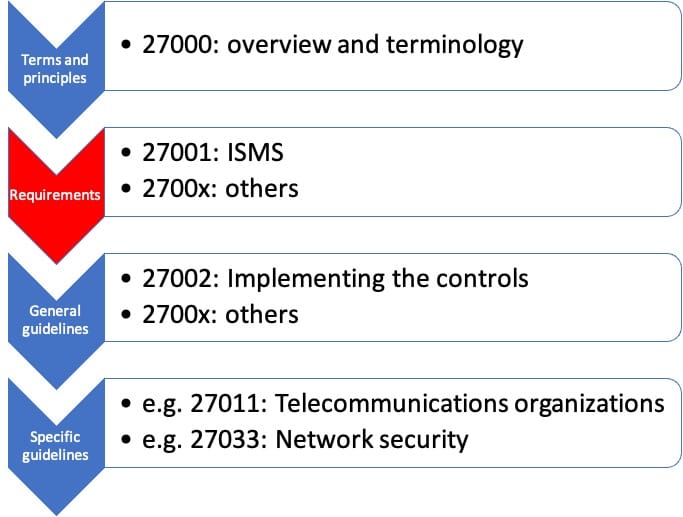
Standardization involves creating unified practices and norms, ensuring everyone uses consistent terminology. The ISO/IEC 27000 series is built on this idea, with ISO/IEC 27000 providing an overview and defining key terms across the standards.
At its core is ISO/IEC 27001, the principal standard for establishing an ISMS. Supporting it is ISO/IEC 27002, a guideline for implementing ISMS controls. The series also includes various guidelines tailored to sector-specific or measure-specific needs.
Standards are categorized as either binding or advisory:
- Normative Standard: Contains mandatory requirements (called "normative elements") that must be implemented. Example: ISO/IEC 27001, which outlines binding ISMS requirements.
- Informative Standard: Provides recommendations and guidance. Example: ISO/IEC 27002, which offers guidance on implementing controls from ISO/IEC 27001 (Annex A).
Understanding the Foundations of ISMS
An ISMS is more than just a standalone security program; it’s an integral part of an organization's overall management system. The primary goal is to maintain the confidentiality, integrity, and availability of data.
To understand how an ISMS works, consider these five guiding questions:
- What assets are we aiming to protect?
- What rules and policies do we establish to secure these assets?
- How do we ensure these rules are documented and compliance is monitored transparently?
- Who is responsible for planning and executing the security measures?
- What concrete actions must be taken to achieve the desired security level?
At the heart of an ISMS are the organization's assets—tangible or intangible resources of value. To protect these, a robust structure of policies, processes, and procedures is needed, ensuring responsibilities are clear and measures are effective on both organizational and technical levels.
ISO/IEC 27001 uses the Plan-Do-Check-Act (PDCA) cycle for continuous improvement, helping organizations regularly assess and enhance their information security levels.
ISO/IEC 27001: Specifications and Minimum Requirements
Applying ISO/IEC 27001 starts with clearly defining the scope for your organization. Achieving compliance means meeting all minimum requirements, without exceptions. The only permissible limitations are those related to Annex A controls.
For ISO/IEC 27001 certification, every requirement must be met. The standard assigns responsibilities to top management, ensuring information security isn’t confined to the IT department. It also mandates that adequate resources are provided for ISMS implementation and improvement.
Internal audits are required to verify that the ISMS meets its objectives. Nonconformities must be corrected as part of continuous improvement, and the standard calls for ongoing risk assessments to determine if preventive measures are needed.
Control Objectives and Measures in an ISMS
Annex A of ISO/IEC 27001 outlines control objectives and measures, serving as a normative component alongside the standard’s core processes. This annex specifies mandatory minimum requirements, just like the main chapters.
Despite listing 93 controls across four domains: organizational, people, physical, and technological. It's not exhaustive. Each organization must determine additional measures needed to protect their assets effectively.
Related Frameworks
Understanding how ISO/IEC 27000 relates to other frameworks is essential for effective ISMS implementation. These two frameworks can offer support and clarify aspects of ISO/IEC 27001:
IT and Information Security Framework
- Name: IT-Grundschutz Kompendium
- Publisher: Federal Office for Information Security (BSI), Germany
- Overview: A collection of recommendations for technical and organizational measures to secure IT infrastructures.
- Structure & Content: The 2023 edition features 105 modules covering areas like security management, organization, personnel, operations, and infrastructure.
IT Governance and Management Frameworks
- Name: COBIT 2019
- Publisher: Information Systems Audit and Control Association (ISACA)
- Overview: A framework for IT governance and management, using a top-down approach to align IT with business goals.
Structure & Content:
- COBIT 2019 Framework: Describes governance and management objectives in detail.
- COBIT 2019 Implementation Guide: Offers strategies for IT governance solutions.
Understanding ISO 27001 Certification
ISO 27001 certification can apply to both organizations and individuals, though there
Organizations can achieve certification for their ISMS through an external audit conducted by an accredited certification body. The scope and content of this audit largely depend on the organization's defined ISMS boundaries and its Statement of Applicability. Thorough preparation for these audits is crucial, and conducting a preliminary audit can help avoid any unwelcome surprises during the official audit.
The audit itself consists of a comprehensive review of documents and records, as well as on-site activities. These on-site assessments typically include interviews and discussions with relevant staff to ensure the ISMS is properly implemented and effective.
Upon successful completion of the audit, the organization is awarded a certification that is valid for up to three years. Additionally, mandatory annual surveillance audits are conducted to ensure continued compliance and effectiveness